
Description
Electrodeionization (EDI) Plant Manufacturer & Supplier in India – V AQUA
Product Overview
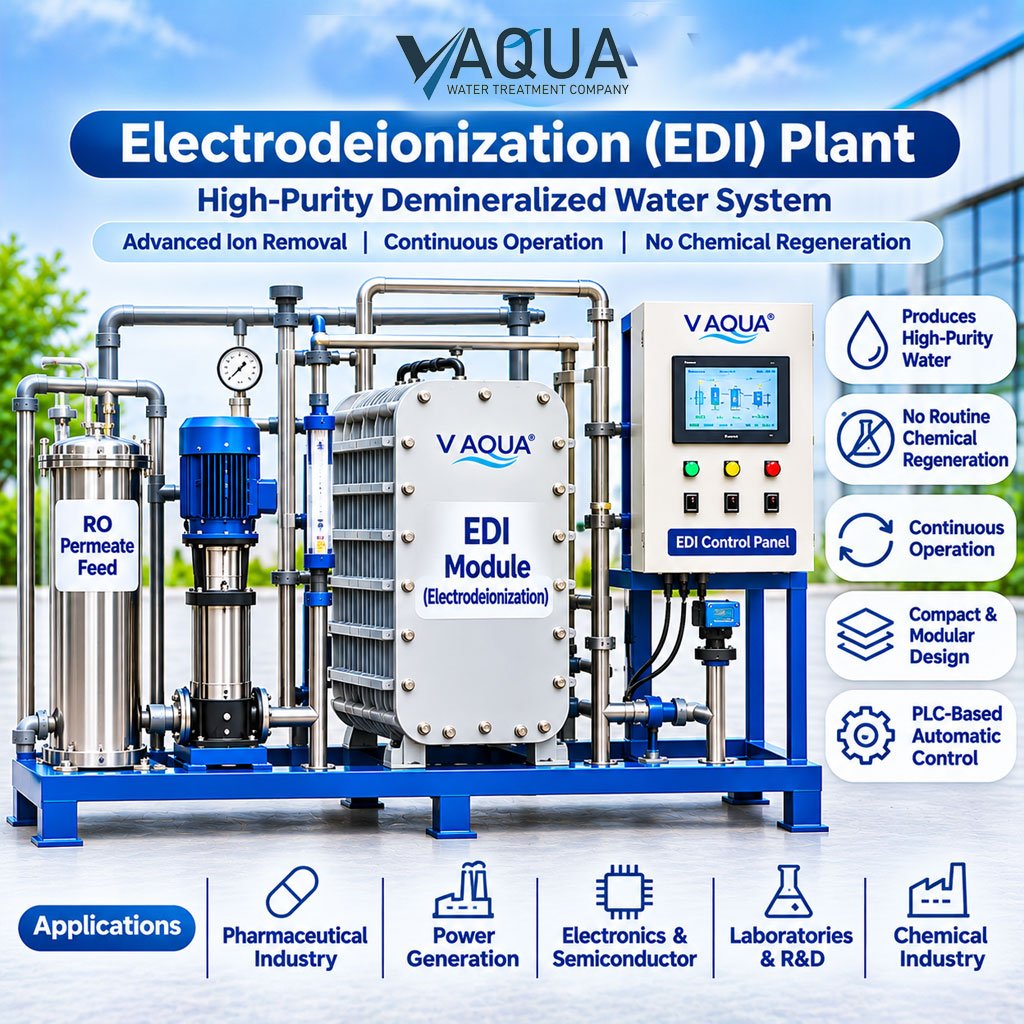
V AQUA designs and supplies advanced Electrodeionization (EDI) Plants for industries that require high-purity and low-conductivity water. EDI is an advanced water purification technology that combines ion exchange resins, ion-selective membranes and direct electrical current to remove dissolved ionic impurities from water.
An EDI Plant is generally installed after a Reverse Osmosis (RO) system to further reduce residual dissolved ions and produce high-purity demineralized water. Unlike conventional DM plants that require periodic chemical regeneration of resin beds, EDI technology continuously regenerates its ion exchange media using electrical energy.
V AQUA provides customised EDI Water Treatment Plants for pharmaceutical industries, power generation facilities, electronics manufacturing, laboratories and other applications where consistent high-quality water is essential.
The system can be designed according to feed water quality, RO permeate flow rate, required product water quality and industrial operating requirements.
Key Features of Electrodeionization (EDI) Plant
- Advanced electrodeionization water purification technology.
- Combines ion exchange resin and ion-selective membranes.
- Uses direct electrical current for continuous resin regeneration.
- Designed for high-purity demineralized water production.
- Generally installed after a suitable RO system.
- Reduces residual dissolved ionic impurities.
- Continuous operation without routine acid and alkali regeneration of the EDI module.
- Compact and modular system configuration.
- Available with PLC-based automatic control panels.
- Designed for industrial and commercial applications.
- Customised treatment capacities and configurations.
How Does an Electrodeionization (EDI) Plant Work?
An EDI Plant uses a combination of ion exchange resins, selective membranes and electrical energy to remove dissolved ions from water.
1. RO Permeate Feed
Pre-treated water, generally produced by a Reverse Osmosis (RO) system, enters the EDI module. RO treatment reduces the dissolved salt concentration before the water reaches the EDI unit.
Proper feed water quality is important for reliable EDI operation and membrane protection.
2. Ion Exchange Process
Inside the EDI module, ion exchange resins capture remaining dissolved cations and anions from the feed water.
The resin helps transport ions through the system and supports efficient removal of residual ionic impurities.
3. Electrical Separation
A direct electrical current is applied across the EDI module. Cation-selective and anion-selective membranes allow positively and negatively charged ions to migrate into separate concentrate compartments.
The dissolved ions are continuously transported away from the product water stream.
4. Continuous Resin Regeneration
The electrical field helps regenerate the ion exchange resins continuously during operation. This reduces the need for conventional chemical regeneration of the EDI module.
5. High-Purity Water Production
The treated water exits the EDI module with significantly reduced ionic content. It can then be supplied to the required industrial process or further polishing equipment, depending on the final water quality specification.
Main Components of an EDI Plant
A typical Electrodeionization Plant may include the following components:
- EDI module or stack
- RO permeate feed system
- High-pressure feed pump, as required
- Electrical power supply unit
- DC power control system
- Flow meters and pressure gauges
- Conductivity or resistivity monitoring instruments
- PLC-based control panel
- Product water and concentrate piping
- Pre-treatment and RO system interface
The exact configuration depends on the selected EDI module, feed water conditions and required production capacity.
Applications of Electrodeionization (EDI) Plant
EDI technology is widely used in industries requiring high-purity water.
- Pharmaceutical industries
- Power generation plants
- Thermal power stations
- Boiler feed water treatment
- Electronics manufacturing
- Semiconductor industries
- Laboratory and research facilities
- Chemical processing industries
- Medical and healthcare-related manufacturing
- Battery manufacturing
- Food and beverage industries
- Industrial process water treatment
Benefits of Installing an EDI Plant
High-Purity Water Production: EDI technology helps remove residual dissolved ions from RO-treated water to produce high-purity demineralized water.
Continuous Operation: The EDI module operates with continuous electrical regeneration of its ion exchange media, reducing the need for routine chemical regeneration.
Reduced Chemical Handling: Unlike conventional chemically regenerated DM systems, EDI modules generally do not require routine acid and alkali regeneration during normal operation.
Consistent Water Quality: Properly designed EDI systems can deliver consistent product water quality when feed water conditions and operating parameters remain within the manufacturer’s limits.
Compact Design: Modular EDI units can be integrated into industrial water treatment plants without requiring large conventional resin regeneration arrangements.
Automation Options: PLC-based controls and online monitoring instruments can be incorporated for convenient operation and performance monitoring.
Integration with RO Systems: EDI can be installed after RO treatment to achieve higher water purity for specialised industrial applications.
Technical Specifications of Electrodeionization (EDI) Plant
| Parameter | Specification |
|---|---|
| Product Name | Electrodeionization (EDI) Plant |
| Brand | V AQUA |
| Treatment Technology | Electrodeionization |
| Purification Process | Ion Exchange + Selective Membranes + DC Current |
| Feed Water | RO Permeate |
| EDI Module | Industrial EDI Stack |
| Ion Exchange Media | Specialised EDI Resin |
| Membrane Type | Cation and Anion Selective Membranes |
| Power Supply | Controlled DC Power Supply |
| Plant Capacity | Customised as per requirement |
| Operating Mode | Automatic |
| Control Panel | PLC-Based |
| Monitoring | Conductivity / Resistivity, Flow and Pressure |
| Installation | Skid-Mounted System |
| Application | High-Purity Industrial Water Treatment |
Note: The above specifications are indicative. Final EDI module selection, capacity, power requirements, feed water quality limits, recovery and product water specifications depend on the selected manufacturer’s design and project requirements.
Feed Water Requirements for an EDI Plant
EDI systems generally require properly pre-treated RO permeate. Feed water quality has a direct impact on EDI performance, product water quality and module life.
Important feed water parameters include:
- Conductivity and total dissolved solids (TDS)
- Hardness
- Silica concentration
- Carbon dioxide concentration
- pH
- Chlorine and oxidising agents
- Suspended solids and turbidity
- Organic contaminants
Suitable pre-treatment and RO system design are essential before supplying water to an EDI module. Feed water must remain within the selected EDI manufacturer’s specified operating limits.
Why Choose V AQUA Electrodeionization (EDI) Plant?
V AQUA Water Treatment Company provides customised industrial water treatment solutions using modern purification technologies. Our EDI systems are designed according to the required water quality, feed water characteristics and industrial production requirements.
Reasons to choose V AQUA:
- Customised EDI water treatment solutions.
- Integration with suitable RO systems.
- Industrial-grade EDI modules and components.
- Automated control and monitoring options.
- Online conductivity and resistivity monitoring options.
- Compact skid-mounted configurations.
- Solutions for pharmaceutical and power industries.
- Support for installation and commissioning requirements.
Whether you require high-purity water for pharmaceutical manufacturing, power generation, electronics production or specialised industrial processes, V AQUA can help you select a suitable EDI water treatment solution.
Frequently Asked Questions
1. What is an Electrodeionization (EDI) Plant?
An Electrodeionization Plant is an advanced water purification system that combines ion exchange resin, selective ion exchange membranes and direct electrical current to remove dissolved ionic impurities from water.
2. What is the difference between an EDI Plant and a DM Plant?
A conventional DM plant generally uses cation and anion exchange resin vessels that require periodic chemical regeneration. An EDI system uses electrical energy and selective membranes to continuously regenerate its ion exchange media during operation.
3. Is RO required before an EDI Plant?
Yes. EDI systems are generally installed after a Reverse Osmosis plant. RO reduces the dissolved salt concentration and removes many contaminants, allowing the EDI module to perform final deionization more effectively.
4. Does an EDI Plant require chemical regeneration?
EDI modules generally do not require routine acid and alkali regeneration during normal operation. However, specialised cleaning or maintenance may be required in certain conditions according to the manufacturer’s recommendations.
5. What water quality can an EDI Plant produce?
A properly designed EDI system can produce very high-purity water with low conductivity and high resistivity. Actual output quality depends on feed water conditions, module selection, operating parameters and system design.
6. Where is an EDI Plant used?
EDI systems are used in pharmaceutical manufacturing, power generation, electronics, semiconductor production, laboratories, chemical industries and other applications requiring high-purity water.
7. Can an EDI Plant operate continuously?
Yes. EDI systems are designed for continuous operation when supplied with feed water within the manufacturer’s specified limits and maintained under recommended operating conditions.
8. What is the capacity of an EDI Plant?
EDI plant capacity can be customised according to the required product water flow rate, feed water quality and final water specifications.
9. What is the difference between EDI and Mixed Bed DM?
A mixed bed DM plant uses cation and anion resins mixed in one vessel and generally requires chemical regeneration. EDI uses membranes, resin and electrical current to continuously remove ions and regenerate the resin media during operation.
Contact V AQUA for Electrodeionization (EDI) Plant
V Aqua Water Treatment Company
- Call: 9560654995 / 7827654995
- Email: sales@vaqua.in
- Website: https://www.vaqua.in/
Contact V AQUA for customised Electrodeionization (EDI) Plants for pharmaceutical, power generation, electronics and other high-purity industrial water treatment applications across India.
Recommended WooCommerce SEO Settings
Product Name: Electrodeionization (EDI) Plant
Focus Keyword: Electrodeionization Plant
Secondary Keywords: EDI Plant, EDI Water Treatment Plant, Industrial EDI System, EDI Demineralization Plant, High Purity Water Treatment Plant
SEO Title: EDI Plant Manufacturer & Supplier in India | V AQUA
URL Slug: electrodeionization-edi-plant
Meta Description: V AQUA offers customised Electrodeionization (EDI) Plants for high-purity water production. Suitable for pharmaceutical, power and industrial applications.
Product Category: Industrial Water Treatment Plants
Product Tags: Electrodeionization Plant, EDI Plant, EDI Water Treatment Plant, EDI System Manufacturer, Industrial EDI Plant, EDI Demineralization Plant, High Purity Water Plant, RO EDI System, Pharmaceutical Water Treatment Plant, Industrial DM Plant
Short Product Description
V AQUA Electrodeionization (EDI) Plant is an advanced water purification system that combines ion exchange resin, selective membranes and electrical current to produce high-purity demineralized water. Generally installed after a Reverse Osmosis (RO) system, it continuously removes residual dissolved ions without routine chemical regeneration of the EDI module. Suitable for pharmaceutical, power generation, electronics and other industrial applications, the system is available in customised capacities.
Product Image ALT Text
V AQUA Electrodeionization EDI Plant – High-Purity Industrial Water Treatment System


