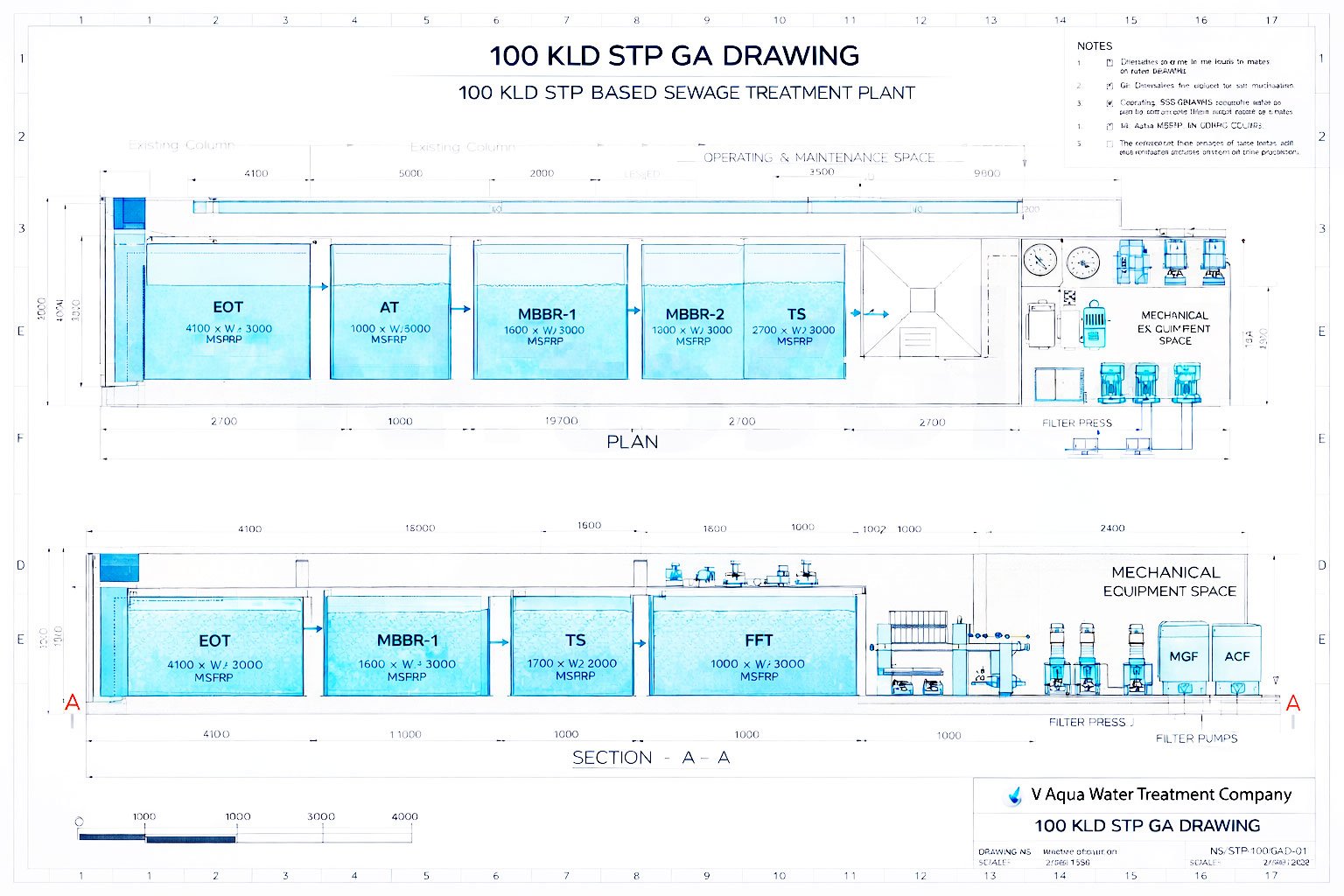
Effective sewage treatment has become an important requirement for large industrial, commercial, residential and integrated development projects. As wastewater generation increases, organizations need reliable sewage treatment systems that can reduce organic pollutants, suspended solids, oil and grease while producing treated water suitable for permitted reuse applications.
As part of its wastewater-treatment solutions, V Aqua Water Treatment Company has supplied and executed a 100 KLD MBBR-based Sewage Treatment Plant (STP) for a project at Mahindra World City, Jaipur, Rajasthan.
The project is designed around a treatment capacity of 100 kilolitres per day (KLD), with a semi-automatic operating mode and an average sewage flow of 5.0 m³/hour. The techno-commercial proposal specifies design, supply, erection and commissioning of the STP system.
Mahindra World City Jaipur is an integrated development spread across approximately 3,000 acres, with industrial, commercial and supporting infrastructure. Its scale makes efficient resource and wastewater management an important part of sustainable site operations.

Project Overview
The 100 KLD STP project was developed to provide an organized wastewater-treatment solution capable of handling domestic sewage generated within the project environment.
Project Details
| Parameter | Details |
|---|---|
| Project | Mahindra World City, Jaipur |
| Location | Jaipur, Rajasthan |
| Plant Capacity | 100 KLD |
| Technology | MBBR / FAB Biological Treatment |
| Nature of Sewage | Domestic Sewage |
| Average Flow | 5.0 m³/hour |
| Peak Flow | 12.5 m³/hour |
| Operating Hours | 20 hours |
| Mode of Operation | Semi-Automatic |
| Scope | Design, Supply, Erection & Commissioning |
| Tertiary Treatment | Multi Grade Filter + Activated Carbon Filter |
| Disinfection | Chlorine Dosing |
| Treated Water Applications | Horticulture and Washing |
| Supplier | V Aqua Water Treatment Company |
The above technical parameters are taken from the 100 KLD STP techno-commercial proposal supplied for the project.
Why a 100 KLD STP Was Required
A sewage treatment plant is essential wherever significant quantities of domestic wastewater are generated from washrooms, toilets, kitchens and associated facilities. Untreated sewage contains organic matter, suspended solids, oil and grease and other contaminants that require controlled treatment before discharge or reuse.
For this project, the proposed system was designed around an average daily sewage flow of 100 KLD. The design basis in the commercial offer specifies raw sewage BOD of 250–300 mg/L, COD of 600–700 mg/L, TSS of 200–250 mg/L, and oil & grease up to 50 mg/L.
The proposed treated-water design targets listed in the offer include:
- pH: 6.5–8.5
- BOD: <20 mg/L
- COD: <60 mg/L
- TSS: <10 mg/L
- Oil & Grease: <5 mg/L
These values represent the design parameters stated in the supplied commercial proposal and should not be interpreted as independent post-commissioning test results.
Technology Used: MBBR/FAB-Based STP
The proposed STP uses MBBR/FAB biological treatment, based on fluidized aeration. This technology provides a large surface area for microorganisms to grow on biofilm media, allowing biological decomposition of organic pollutants within the aeration stage.
According to the supplied proposal, the technology was selected for advantages including comparatively smaller floor-space requirements, reduced civil construction requirements, faster execution, lower operating costs, lower sludge generation and easier operation and maintenance. The proposal also notes that the system does not require biomass recirculation.
The MBBR/FAB stage is therefore the biological heart of the proposed 100 KLD STP.
The process allows microorganisms to utilize organic pollutants present in sewage as part of the biological treatment process. Aeration is maintained using air blowers and diffusers, creating the required aerobic environment for biological activity.
Treatment Process of the 100 KLD STP
The complete treatment scheme specified in the offer includes:
Bar Screen → Oil & Grease Trap → Equalization Tank → MBBR Reactor 1 & 2 → Tube Settler → Chlorine Contact Tank → Multi Grade Filter → Activated Carbon Filter → Treated Water
The system also incorporates sludge handling facilities.
Let’s understand each stage.
1. Bar Screen Chamber
The first stage is the bar screen chamber.
Incoming sewage can contain larger physical materials such as plastic, cloth, vegetables and other debris. The bar screen helps prevent these materials from entering downstream treatment equipment.
The commercial offer specifies a 500 × 500 mm MSEP bar screen for this purpose.
2. Oil & Grease Trap
After screening, wastewater passes through an oil and grease trap.
Oil and grease are lighter than water and can separate toward the surface. The system allows this material to be removed periodically before wastewater moves to the equalization stage.
The process description specifies approximately 15 minutes of settling time in this stage.
3. Equalization Tank
The equalization tank receives wastewater from the oil and grease trap.
Its main purpose is to homogenize wastewater characteristics and balance fluctuations in flow and pollutant concentration before biological treatment.
From the equalization tank, sewage is transferred to the MBBR reactors through sewage transfer pumps.
4. MBBR/FAB Reactor
The equalization tank is followed by the biological treatment stage.
The supplied design includes two MBBR reactors. Air is supplied through the aeration system, creating the oxygen-rich environment required for microorganisms.
The biological process converts biodegradable organic matter into biological sludge flocs. Fine-bubble aeration is used to maintain mixing and oxygen availability in the reactor.
The proposal specifies FAB/MBBR media with a trapezoidal cylindrical shape, density of 0.93 gm/cc and specific weight listed as 0.47 kg/m².
5. Tube Settler
Following biological treatment, the water enters a tube settler.
The tube settler is designed to separate biological sludge from clarified water. Sludge settles toward the conical bottom while comparatively clear water overflows from the top and moves toward the chlorine contact tank.
The proposal specifies 750 mm PVC tube settler media with a V-type structure.
6. Chlorine Contact Tank
The clarified water then enters the chlorine contact tank.
This stage provides storage/contact time for chlorination and also acts as the feed source for the tertiary filtration system.
The commercial offer includes a dedicated chlorine dosing system consisting of a dosing pump and dosing tank.
7. Multi Grade Filter
Water from the chlorine contact tank is pumped to the Multi Grade Filter (MGF).
The MGF is intended to remove remaining suspended solids, dirt, iron and silt and produce cleaner water for the next filtration stage.
The proposed MGF uses an FRP pressure vessel, 24-inch diameter, 72-inch height of shell (HOS) and a 50 mm multiport valve. Its media arrangement includes gravels, pebbles and quartz sand with a specified bed depth of 1,000 mm.
8. Activated Carbon Filter
After the Multi Grade Filter, water passes through the Activated Carbon Filter.
The ACF provides additional polishing and is intended to help reduce colour, smell and odour.
The offer specifies an FRP pressure vessel, 24-inch diameter, 72-inch HOS, top-and-bottom openings and a 50 mm multiport valve. The media includes activated carbon, pebbles and quartz sand, with a specified bed depth of 1,000 mm.
9. Sludge Handling
Biological treatment and clarification generate sludge that must be managed properly.
The proposed system includes sludge transfer arrangements for moving sludge from the tube settler to sludge dry beds.
The commercial offer specifies a sludge transfer pump with a capacity of 1.5 m³/hour, with CI construction, and two units listed in a working/standby arrangement.
Detailed Product Specification of 100 KLD STP
The following specifications are taken directly from the supplied V Aqua commercial offer.
| Equipment | Specification |
|---|---|
| STP Capacity | 100 KLD |
| Operating Hours | 20 hours |
| Mode | Semi-Automatic |
| Average Flow | 5.0 m³/hr |
| Peak Flow | 12.5 m³/hr |
| Bar Screen | 500 × 500 mm, MSEP |
| Sewage Transfer Pump | Multistage submersible |
| Pump Capacity | 5.0 m³/hr |
| Pump Head | 8–10 m |
| Pump MOC | CI |
| Air Blower | Twin Lobe |
| Blower Capacity | 100 m³/hr/blower |
| Blower Head | 4.5 m |
| Air Distribution Grid | GI |
| Air Diffusers | Coarse disc / fine tubular / silicon fine diffuser |
| FAB/MBBR Media | Trapezoidal cylindrical |
| MBBR Media Density | 0.93 gm/cc |
| Tube Settler Media | PVC, 750 mm, V-type |
| Chlorine Dosing Pump | Diaphragm type |
| Dosing Pump Capacity | 0–6 LPH |
| Dosing Tank | 100 litres, HDPE |
| Filter Feed Pump | Horizontal centrifugal |
| Filter Feed Flow | 3.75 m³/hr |
| Filter Feed Head | 25–30 m |
| Multi Grade Filter Vessel | FRP, 24″ × 72″ |
| MGF Valve | 50 mm multiport |
| MGF Media | Gravels, pebbles, quartz sand |
| MGF Bed Depth | 1,000 mm |
| Activated Carbon Filter | FRP, 24″ × 72″ |
| ACF Valve | 50 mm multiport |
| ACF Media | Activated carbon, pebbles, quartz sand |
| ACF Bed Depth | 1,000 mm |
| Sludge Transfer Pump | 1.5 m³/hr, CI |
| Electrical Control Panel | Included |
| Inlet Flow Meter | Electromagnetic |
| Level Switches | EQT, chlorine contact & sludge holding tanks |
| Outlet Flow Measurement | Rotameter at ACF outlet |
These specifications are consolidated from the equipment schedule and related pages of the commercial proposal.
Fabricated Tanks Included in the Proposal
The proposal also identifies MSEP-fabricated tanks/equipment associated with the system.
These include:
- 2 MBBR reactors
- 1 tube settler tank
- 1 chlorine contact tank
- 1 sludge dry bed
The capacities of these units are stated as being as per drawing in the proposal.
The civil-work section separately identifies the following client-scope items:
- Bar screen chamber
- Oil and grease chamber
- Equalization tank
- Treated water tank
- Foundation
- Plant room/shade, as required
These scope boundaries are important because the complete STP installation does not mean every civil and site-related activity is necessarily included within the equipment supplier’s scope.
Electrical and Control System
A properly designed STP needs monitoring and control equipment to maintain reliable operation.
The proposed 100 KLD plant includes an electrical control panel with starters, overload relays, single-phase protection, voltmeter, ammeter, MCBs, indication lights, push buttons, rocker switches, incomers and auto/manual switches.
The control instrumentation includes:
- Electromagnetic flow meter at sewage inlet
- Level switches in the equalization tank
- Level switch in chlorine contact tank
- Level switch in sludge holding tank
- Rotameter at ACF outlet
These instruments help operators monitor flow and tank levels during plant operation.
Major Equipment Makes
The commercial offer also provides a list of proposed makes for major components.
Some of the listed options include:
- Mono-block Pumps: Kirloskar / CRI / Lubi
- MS/GI Pipe: Jindal / Tata / Surya
- Dosing Pump: Edose / Initiative
- UPVC/CPVC Piping: Astral / Supreme
- Butterfly Valve: Sant / Zoloto
- Pressure Gauges: H Guru / Forbes Marshal
- Air Blower: Kay / Airvac / Everest
- Motors: Kirloskar / CG / ABB
- Submersible Sewage Pump: Kirloskar / CRI / equivalent
- FAB/MBBR Media: V Aqua approved
- Tube Deck Media: V Aqua approved
- Switch Gear: L&T / Schneider / equivalent
- Wiring & Cabling: Finolex / Polycab / Havells
Scope of Work by V Aqua
The commercial offer identifies the principal scope as:
Design → Supply → Erection → Commissioning
The proposal states that V Aqua’s scope includes erection of the units under its supply scope and commissioning of the sewage treatment plant.
At the same time, several activities are identified as owner/client scope, including site access and storage, continuous power/water availability, incoming electrical feeder connection, treated-water pipeline beyond the STP outlet, civil work, required NOCs, boarding/lodging of the erection team and loading/unloading at site.
This distinction is particularly important in an STP project because successful commissioning depends not only on treatment equipment but also on civil works, utilities, piping and site readiness.
Maintenance Requirements for the 100 KLD STP
The commercial offer provides specific operational and maintenance recommendations.
Preliminary Treatment
Solid waste and floating debris should be removed regularly from the inlet chamber and screens. Oil and grease should be removed from the oil and grease trap on a weekly basis.
Sand Filter
The proposal recommends daily backwashing for 15 minutes to maintain filtration efficiency.
Carbon Filter
The carbon filter is also specified for daily 15-minute backwashing to support removal of odour, colour and organic contaminants.
Sludge Management
Sludge accumulation in the tube settler should be monitored regularly. When excess sludge is present, it should be removed using the sludge pump.
Blower Maintenance
The blower air filters require periodic cleaning/replacement as needed, while timely lubrication and oil maintenance are recommended for continuous aeration performance.
Pump Safety
Pumps should be operated according to standard operating procedures and protected from dry running by switching them off automatically or manually when water is unavailable.
Expected Treated Water Applications
The commercial proposal specifically identifies horticulture and washing as intended uses of treated water from the STP.
This approach can help reduce dependence on fresh water for suitable non-potable applications when the treated water meets the applicable reuse requirements and the project has the necessary infrastructure.
For a large integrated development such as Mahindra World City Jaipur, efficient wastewater management can form an important part of broader resource-efficiency objectives. Mahindra Lifespaces describes the Jaipur development as an integrated city incorporating industrial, commercial and supporting infrastructure with a stated focus on sustainability.
Commercial Offer Details
The supplied techno-commercial proposal is dated 16 June 2026 and references a requirement for a 100 KLD Sewage Treatment Plant.
The offer lists the price for design, supply, installation, testing and commissioning of the MBBR-based 100 KLD STP at ₹19,75,000, for one plant, with GST extra. It states that installation is included, while plumbing materials at site and transport are identified as client scope/as actual respectively.
The stated payment schedule is:
- 70% advance with technically and commercially clear purchase order
- 20% against proforma invoice before dispatch
- 10% after successful commissioning at site
The offer validity is stated as 60 days from the date of the offer.
Because these are commercial-offer terms rather than a current quotation, they should be reconfirmed with V Aqua before being used for a new purchase decision.
Warranty
The proposal specifies a 12-month warranty from the date of dispatch, subject to the equipment being operated and maintained according to V Aqua’s instructions and the issue arising from proven faulty design, materials or workmanship.
The warranty also includes conditions concerning bought-out components, electrical components and instruments, and excludes normal wear and tear and damage arising from mal-operation, accidents or other specified circumstances.
Why MBBR Is Suitable for a 100 KLD STP
MBBR technology is widely used for domestic sewage treatment because it combines biological treatment with a relatively compact reactor arrangement.
For this 100 KLD design, the major advantages identified in the supplied proposal include:
- Compact biological treatment arrangement
- Reduced floor-space requirement
- Lower civil construction requirement for suitable configurations
- Faster installation
- Lower sludge generation
- No biomass recirculation requirement
- Simple operation and control
- Flexible biological treatment
- Support for nitrification and denitrification
- Easier operation and maintenance
These characteristics make MBBR a practical technology for many residential, commercial, institutional and industrial-campus wastewater applications.
V Aqua Water Treatment Company – STP Solutions
V Aqua Water Treatment Company provides wastewater and water-treatment solutions including STP, ETP, RO, UF and water-treatment systems. The supplied proposal describes V Aqua as a Delhi/NCR-based water-treatment company serving industrial, commercial and residential applications.
V Aqua’s current online information also describes its STP offering around technologies such as MBBR, SBR and MBR, with design, installation, commissioning and maintenance services.
For organizations planning a new sewage treatment plant, the appropriate capacity and process configuration should be determined from actual sewage quantity, wastewater characteristics, site conditions, reuse objectives and applicable regulatory requirements.
V Aqua Water Treatment Company
Contact at : 9560654995, Emails: sales@vaqua.in
Conclusion
The 100 KLD MBBR-based STP project at Mahindra World City, Jaipur represents a complete biological and tertiary wastewater-treatment configuration designed for handling 100,000 litres of sewage per day.
The proposed treatment sequence—screening, oil and grease separation, equalization, MBBR biological treatment, tube settling, chlorination, multi-grade filtration and activated carbon filtration—provides a structured approach to treating domestic sewage and producing treated water for specified non-potable applications.
The commercial offer provides detailed equipment specifications covering pumps, blowers, diffusers, MBBR media, tube settlers, dosing systems, MGF, ACF, sludge handling, electrical controls and instrumentation.
For a large-scale integrated development such as Mahindra World City Jaipur, an appropriately designed STP can support responsible wastewater management while enabling treated-water reuse for applications such as horticulture and washing, subject to applicable standards and project requirements.
V Aqua Water Treatment Company provides the engineering, equipment and commissioning expertise required for customized STP solutions across different capacities and applications.
FAQs
What is the capacity of the STP installed at Mahindra World City Jaipur?
The project is based on a 100 KLD sewage treatment plant, equivalent to a design capacity of 100,000 litres per day.
Which technology is used in the 100 KLD STP?
The supplied commercial proposal specifies an MBBR/FAB-based biological treatment system followed by tube settling, chlorination, multi-grade filtration and activated carbon filtration.
What is the average flow of the plant?
The design basis specifies an average flow of 5.0 m³/hour and peak flow of 12.5 m³/hour.
What type of sewage is the plant designed to treat?
The proposal specifies domestic sewage as the nature of the effluent.
What can the treated water be used for?
The commercial offer identifies horticulture and washing as uses of treated water.
Who supplied and commissioned the STP?
The techno-commercial proposal identifies V Aqua Water Treatment Company as the supplier and includes design, supply, erection and commissioning within the stated scope.
What is the quoted price for the 100 KLD STP?
The supplied commercial offer lists ₹19.75 lakh for one MBBR-based 100 KLD STP, with GST extra. The offer also specifies installation as included, while certain site plumbing and transportation items are identified separately.
Is the 100 KLD STP fully automatic?
The supplied proposal specifies the mode of operation as semi-automatic.
What is the warranty period?
The proposal specifies a 12-month warranty from the date of dispatch, subject to the stated warranty conditions.