

Description
MVR-Based ZLD Plant – Manufacturer & Supplier in India
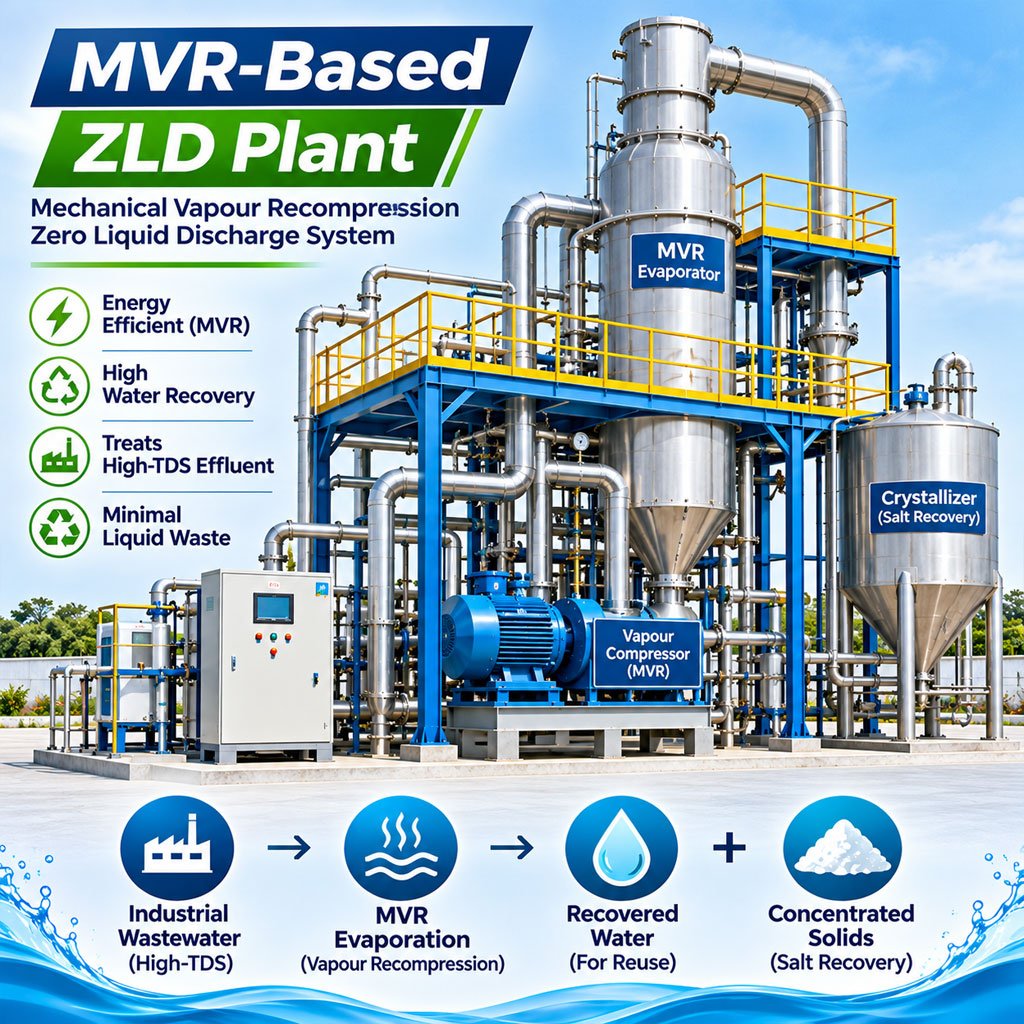
An MVR-Based ZLD Plant (Mechanical Vapour Recompression-Based Zero Liquid Discharge Plant) is an advanced industrial wastewater treatment solution designed to recover reusable water from concentrated industrial effluent while minimizing liquid waste discharge. It combines Mechanical Vapour Recompression (MVR) technology with evaporation and, where required, crystallization to achieve efficient wastewater concentration and water recovery.
V Aqua offers customized MVR-Based Zero Liquid Discharge solutions for industries dealing with high-TDS wastewater, RO reject, and concentrated industrial effluent. These systems are designed to reduce dependence on conventional steam-based evaporation, improve energy utilization, and support sustainable industrial water management.
What Is an MVR-Based ZLD Plant?
An MVR-Based ZLD Plant uses Mechanical Vapour Recompression technology to recover and reuse the energy contained in generated water vapour during the evaporation process.
In this technology, vapour produced during evaporation is compressed mechanically, increasing its pressure and temperature. The compressed vapour is then reused as a heating medium within the evaporator, reducing the requirement for additional external thermal energy.
The evaporation process separates water from concentrated wastewater, producing recovered condensate and a concentrated liquid stream. The remaining concentrate can be further processed through a crystallizer to separate dissolved salts into solid form.
This technology is particularly useful for industries looking to recover water from concentrated wastewater while optimizing energy consumption.
Key Features of V Aqua MVR-Based ZLD Plants
- Mechanical Vapour Recompression Technology: Reuses generated vapour as a heating source through mechanical compression.
- Energy-Efficient Evaporation: Reduces dependence on fresh steam during normal operation, although electrical energy is required to operate the compressor.
- High Water Recovery Potential: Recovers water from concentrated industrial wastewater.
- High-TDS Wastewater Treatment: Suitable for industrial effluent and concentrated RO reject streams.
- Reduced Liquid Waste: Minimizes liquid wastewater generation when integrated with appropriate downstream treatment.
- Customized Plant Design: Designed according to wastewater composition, capacity, and recovery requirements.
- Crystallizer Integration: Optional crystallization stage for salt separation and solid residue recovery.
- Automated Operation: PLC-based control systems and process monitoring options.
- Industrial-Grade Equipment: Construction materials selected according to wastewater chemistry and operating conditions.
How Does an MVR-Based ZLD Plant Work?
An MVR-Based ZLD system operates through a series of treatment and evaporation stages to recover water and concentrate dissolved solids.
1. Wastewater Collection and Pre-Treatment
Industrial wastewater is collected and passed through suitable pretreatment processes to remove suspended solids, oil, grease, and other contaminants.
Depending on wastewater quality, pretreatment may include:
- Screening and filtration
- Chemical dosing
- pH correction
- Clarification
- Ultrafiltration
- Reverse osmosis
2. Concentrated Wastewater Feeding
The pre-treated wastewater or concentrated RO reject is transferred to the MVR evaporator using suitable feed pumps.
The feed system is designed according to the wastewater characteristics and required evaporation capacity.
3. Evaporation Process
The wastewater enters the evaporator, where heat is used to evaporate a portion of its water content.
As evaporation continues, the concentration of dissolved salts and other non-volatile substances increases in the remaining liquid.
4. Mechanical Vapour Recompression
The vapour generated during evaporation is collected and passed through a mechanical compressor.
The compressor increases the vapour pressure and temperature, allowing it to be reused as a heating medium in the evaporator.
This energy-recovery arrangement significantly reduces the requirement for continuous external heating compared with conventional evaporation configurations.
5. Condensation and Water Recovery
The compressed vapour transfers its heat to the incoming wastewater and condenses.
The resulting condensate is collected as recovered water, which can be reused in suitable industrial applications after meeting the required quality standards.
6. Crystallization and Salt Recovery
The concentrated liquid remaining after evaporation can be transferred to a crystallizer for further concentration and separation of dissolved salts.
The resulting solid residues are collected and handled according to their composition and applicable disposal or recovery requirements.
Applications of MVR-Based ZLD Plants
MVR-Based Zero Liquid Discharge systems are suitable for industries that generate concentrated wastewater and require efficient water recovery.
Major industrial applications include:
- Textile and dyeing industries
- Pharmaceutical manufacturing plants
- Chemical and petrochemical industries
- Distillery and ethanol manufacturing plants
- Sugar processing industries
- Power generation facilities
- Fertilizer manufacturing units
- Paper and pulp industries
- Food and beverage processing plants
- Tanneries and leather industries
- Industrial RO reject treatment
- Chemical processing facilities
- General manufacturing industries
Benefits of Installing an MVR-Based ZLD Plant
1. Improved Energy Utilization
MVR technology recycles generated vapour energy through mechanical compression, reducing the need for additional external heating during normal operation.
2. High Water Recovery
The system recovers water from concentrated wastewater through evaporation and condensation, helping industries improve water recycling.
3. Reduced Steam Consumption
Compared with conventional steam-driven evaporation systems, MVR technology can significantly reduce fresh steam requirements, depending on operating conditions and system design.
4. Effective High-TDS Wastewater Treatment
MVR evaporators can process concentrated industrial wastewater and RO reject streams, subject to appropriate pretreatment and material selection.
5. Reduced Liquid Waste Generation
When integrated with suitable crystallization and residue management systems, MVR-based ZLD plants help minimize liquid waste discharge.
6. Sustainable Industrial Water Management
Recovered water can be reused in suitable industrial applications, reducing dependence on freshwater resources.
7. Compact Process Configuration
MVR systems can offer an efficient evaporation configuration with fewer evaporation effects compared with some conventional MEE arrangements, depending on project requirements.
MVR-Based ZLD Plant – Technical Specifications
The technical configuration of an MVR-Based ZLD Plant depends on feedwater quality, TDS concentration, evaporation load, and required water recovery.
| Parameter | Details |
|---|---|
| Plant Type | MVR-Based ZLD Plant |
| Full Form | Mechanical Vapour Recompression |
| Main Technology | MVR Evaporation |
| Application | Industrial wastewater treatment |
| Feedwater | RO Reject / Concentrated Effluent |
| Evaporation System | Mechanical Vapour Recompression |
| Vapour Compression | Mechanical Compressor |
| Heat Source | Recompressed Vapour |
| Additional System | Crystallizer, as required |
| Water Recovery | Based on feedwater characteristics |
| Automation | Manual / Semi-Automatic / PLC |
| Construction Material | SS 304 / SS 316 / Other suitable materials |
| Installation | Indoor or Outdoor |
| Plant Capacity | Customized as per requirement |
MVR-Based ZLD Plant vs MEE-Based ZLD Plant
Both technologies are used for industrial wastewater concentration, but their energy utilization methods are different.
| Parameter | MVR-Based ZLD | MEE-Based ZLD |
|---|---|---|
| Technology | Mechanical vapour compression | Multiple effect evaporation |
| Energy Recovery | Mechanical vapour recompression | Vapour reuse across effects |
| Main Energy Input | Electricity | Primarily steam or thermal energy |
| Steam Requirement | Generally lower | Depends on number of effects |
| Compressor | Required | Generally not required |
| Application | Industrial wastewater concentration | Industrial wastewater concentration |
| Selection | Depends on electricity and process economics | Depends on steam availability and process economics |
The right technology should be selected after evaluating wastewater characteristics, electricity tariffs, steam availability, operating costs, and project requirements.
Why Choose V Aqua for MVR-Based ZLD Plants?
V Aqua provides customized industrial water and wastewater treatment solutions for different manufacturing sectors.
Reasons to consider V Aqua include:
- Customized MVR plant engineering and design
- Advanced mechanical vapour recompression technology
- Solutions for high-TDS industrial wastewater
- Integration with RO and pretreatment systems
- Evaporator and crystallizer integration options
- Industrial-grade equipment and components
- Automated process control options
- Installation and commissioning support
- Technical assistance and after-sales service
Our focus is to help industries recover water, reduce wastewater disposal requirements, and improve overall process efficiency.
MVR-Based ZLD Plant Price in India
The price of an MVR-Based ZLD Plant in India depends on several technical and operational factors, including:
- Daily wastewater generation in KLD
- Feedwater TDS concentration
- Complete wastewater chemical composition
- Required evaporation capacity
- Water recovery requirements
- Compressor capacity and configuration
- Electricity consumption
- Construction material selection
- Crystallizer requirements
- Automation and instrumentation
A customized engineering assessment is recommended to determine the most suitable MVR system and project cost.
Contact V Aqua for a customized MVR-Based ZLD Plant quotation.
Frequently Asked Questions (FAQs)
1. What is an MVR-Based ZLD Plant?
An MVR-Based ZLD Plant is an industrial wastewater treatment system that uses Mechanical Vapour Recompression technology to recover water through evaporation and condensation while minimizing liquid waste discharge.
2. What is the full form of MVR?
MVR stands for Mechanical Vapour Recompression. It is an energy-recovery technology in which generated vapour is mechanically compressed and reused as a heating medium.
3. How does an MVR evaporator save energy?
An MVR evaporator compresses the vapour generated during evaporation, increasing its temperature and pressure so that it can be reused for heating. This reduces the requirement for fresh external steam or thermal energy.
4. Can an MVR-Based ZLD Plant treat RO reject water?
Yes. MVR systems can be designed to treat concentrated RO reject and other high-TDS industrial wastewater streams after suitable pretreatment.
5. What is the difference between MVR and MEE technology?
MVR uses a mechanical compressor to recycle generated vapour energy, whereas MEE uses multiple evaporation effects to reuse vapour as a heating medium across different stages.
6. Is a crystallizer required in an MVR-Based ZLD Plant?
A crystallizer is generally included when the project requires further processing of concentrated brine to separate dissolved salts into solid form.
7. Is recovered water from an MVR plant reusable?
Yes. Condensate recovered from the MVR system can be reused for suitable industrial applications after checking its quality and providing additional treatment where necessary.
Get a Customized MVR-Based ZLD Plant from V Aqua
Looking for a reliable MVR-Based ZLD Plant Manufacturer and Supplier in India? V Aqua offers customized Mechanical Vapour Recompression-based Zero Liquid Discharge solutions for industrial wastewater treatment, RO reject management, water recovery, and salt separation.
Whether you need an MVR system for a textile factory, pharmaceutical facility, chemical industry, or distillery plant, our team can help you identify a suitable treatment configuration.
Contact V Aqua today for technical consultation and a customized project quotation.
V Aqua – Industrial Water & Wastewater Treatment Solutions
Website: https://www.vaqua.in/
Phone: +91 9560654995
Email: sales@vaqua.in


